South Africa’s warehousing and logistics sector has already made its choice on electric material handling — most operators simply have not seen the numbers that prove it. Electric machines accounted for roughly 67.8% of South African forklift market revenue in 2025, according to Grand View Research, and electric is the fastest-growing power source segment in the country. This is no longer an emerging trend. It is the majority of the market.
What has not kept pace is the quality of the conversation around it. Too much of the advice available to South African operators is either a sustainability argument that finance directors have learned to tune out, or a sales pitch that quotes a saving without ever seeing the customer’s data. Neither helps you make a capital decision.
This guide takes a different approach. It sets out what electric forklifts genuinely cost to run, what lithium-ion battery technology does and does not change, how to keep a fleet moving through grid interruptions, what your legal obligations are as an employer, and — importantly — where diesel still makes more sense. The aim is to leave you able to interrogate any supplier’s proposal, including ours.
With more than 25 years of industry experience, Orizen Group helps South African businesses make this transition using operational data rather than assumption. We work across electric forklifts, lithium-ion battery systems, reach trucks, pallet trucks and aftersales support, and we build every recommendation around Total Cost of Ownership (TCO) rather than purchase price.
Electric Forklift Trends in South Africa
Warehouses, factories and distribution centres across South Africa are replacing diesel and lead-acid equipment with modern electric material handling fleets. The motivation is rarely environmental in the first instance. It is operational: reduce running costs, improve uptime, and keep equipment productive for longer.
The market data supports what we see on customer sites. Grand View Research places electric at approximately 67.8% of South African forklift revenue in 2025 and identifies it as the fastest-growing power source segment through 2033. Independent estimates of the market’s total value differ depending on what each analyst includes, but they agree on direction — the South African forklift market is growing, and electric is taking a larger share of it each year.
Three forces are driving that shift locally. E-commerce and modern retail distribution have raised the premium on throughput and accuracy inside the building. Lithium-ion battery technology has matured to the point where electric equipment handles multi-shift work that would once have required a diesel machine. And diesel’s operating cost has become markedly harder to budget, which has pushed fleet economics up the agenda in businesses that previously bought on purchase price alone.
Why Businesses Are Switching to Electric
The decision to move to electric forklifts is no longer made on sustainability grounds alone. It is made because the equipment delivers better value across its working life.
Fewer moving parts means less maintenance
An electric forklift has no engine oil, no fuel filters, no exhaust system and no transmission of the kind a diesel machine requires. That removes entire categories of scheduled servicing and reduces the frequency of unplanned workshop time. Less time in the workshop is more time moving pallets, and for most operations that availability is worth more than the servicing saving itself.
Lower and more predictable energy cost
Electric machines convert energy to work more efficiently than combustion equipment, and electricity is billed per kilowatt-hour on a tariff you can plan around. Businesses that add solar generation take this further, moving a portion of their energy cost onto an asset they own rather than a fuel they import.
A better working environment
Electric forklifts produce zero exhaust emissions at the point of use and run quietly enough to hold a conversation alongside. In enclosed warehouses, food and beverage facilities and cold storage, that is not a comfort feature — it is often the deciding factor, because ventilating combustion exhaust in a sealed space is expensive and imperfect.
Charging that fits the shift
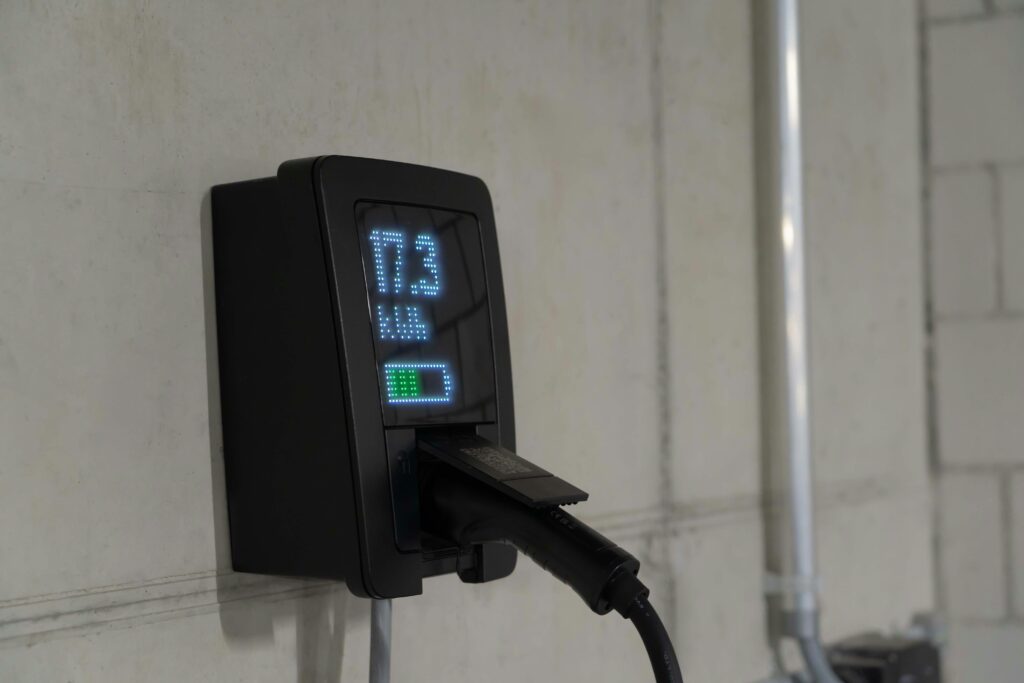
Advances in lithium-ion technology changed how electric equipment is used. Faster charging, longer operating hours and opportunity charging during natural breaks mean a machine can stay available across a full working day without the battery-changing infrastructure that lead-acid fleets require.
Electric vs Diesel Forklifts: The Full Comparison
Choosing between electric and diesel is not a question of conviction. It is a question of matching a machine to a duty cycle, an environment and a cost structure. The table below compares the two across the factors that actually determine performance and cost over a working life.
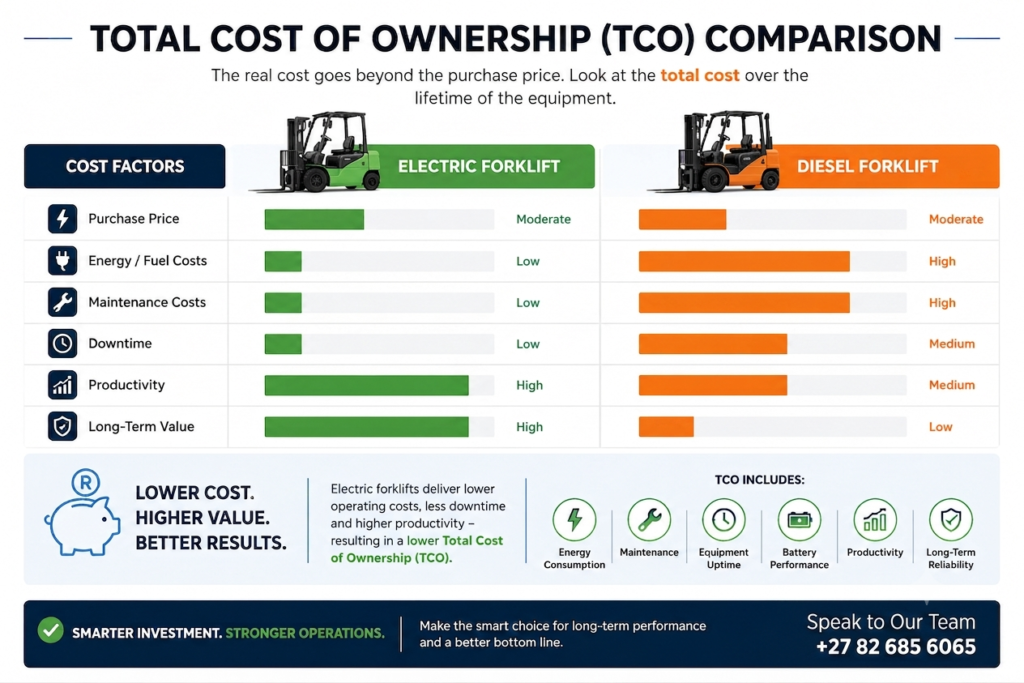
Electric vs diesel forklift comparison — operating cost, maintenance, emissions and noise.
| Factor | Electric forklift (lithium-ion) | Diesel forklift |
|---|---|---|
| Energy source | Grid electricity — compatible with solar and battery storage | Imported diesel fuel |
| Cost predictability | Priced per kWh; can be fixed, self-generated or scheduled | Moves monthly with the oil price and the rand |
| Routine maintenance | Fewer moving parts. No engine oil, filters, belts or exhaust servicing | Regular engine servicing, oil, filters and exhaust work |
| Refuel / recharge time | 1–2 hours for a full lithium-ion charge; 15–30 minute opportunity charges during breaks | A few minutes to refuel |
| Emissions at point of use | Zero exhaust emissions | Exhaust emissions including particulates and NOx |
| Noise | Quiet enough for conversation alongside the machine | Noisy — contributes to operator fatigue |
| Indoor suitability | Ideal | Restricted. Requires significant ventilation |
| Best-fit applications | Warehousing, distribution, cold storage, food and beverage, manufacturing, retail DCs | Rough outdoor terrain, heavy yard duty, remote sites without power |
| Upfront cost | Higher, driven mainly by the battery | Lower |
| Total cost of ownership | Typically lower across a 5–7 year life | Typically higher once fuel and servicing accumulate |
Read the table as a matching exercise, not a scoreboard. For an indoor, multi-shift distribution operation, electric wins on almost every line that matters. For a rough outdoor yard running continuously with no practical charging window, diesel may still be the correct engineering answer. Most South African operations of any scale end up running a mixed fleet, and there is nothing unsophisticated about that.
What Total Cost of Ownership Actually Includes
Every forklift supplier talks about Total Cost of Ownership. Very few show what sits inside it. That omission matters, because the purchase price is the one cost procurement scrutinises line by line, and it is usually the smallest part of what a machine costs over five to seven years.
Here is what a complete TCO model contains.
| Cost line | What it actually covers |
|---|---|
| Purchase or finance cost | The invoice price, or the monthly instalment. The most visible cost, and usually the smallest share of the total. |
| Energy | Diesel litres versus kWh consumed. Electric typically wins here, and the gap widens every time fuel prices move. |
| Battery replacement | A second capital event most buyers never price at purchase. Cycle life determines when it lands. |
| Routine maintenance | Services, consumables, wear parts. Fewer moving parts means fewer scheduled interventions. |
| Unplanned repairs | Harder to forecast, but historically higher on combustion equipment. |
| Downtime | The most expensive line on this list, and the only one that never appears on an invoice. |
| Operator productivity | Pallets moved per hour, compounded across every shift the machine runs. |
| Charging or refuelling infrastructure | Charger capacity, electrical work, fuel storage and bunding. Site-specific and often underestimated. |
| Residual value | What the machine is worth when you are finished with it. |
Downtime deserves particular attention, because it punishes you twice. A machine standing still is not simply unproductive. It strands the labour scheduled around it, delays the orders queued behind it, and puts pressure on the service commitments you have made to your own customers. It is the largest hidden cost in most fleets and the one least likely to appear in a supplier’s comparison.
The practical implication is straightforward. Ask any supplier — including us — to model these lines against your actual running hours, energy tariff and maintenance history. A proposal that compares only purchase prices is not a TCO analysis, whatever it is called.
How Lithium-Ion Batteries Changed Warehouse Operations
A lithium-ion battery charges fully in roughly one to two hours and requires no cooling period. More importantly, it can be opportunity charged — plugged in for 15 to 30 minutes during a tea break, a lunch break or a shift changeover — without damaging the pack. A lead-acid battery must complete a full charge cycle of around eight hours, followed by a similar cooling period, and cannot be routinely opportunity charged without shortening its life.
The operational consequence is significant. Multi-shift lead-acid fleets typically need spare batteries, a dedicated charging bay and lifting equipment to change packs weighing hundreds of kilograms. A lithium fleet often runs the same battery across multiple shifts, which removes the spare battery inventory, the changing bay and the labour associated with both.
Consistent power through the shift
Lithium-ion maintains a flatter discharge curve, meaning the machine performs at close to full power for a much larger portion of the cycle rather than slowing noticeably as the battery depletes. Lead-acid is also less energy-efficient, with a meaningful share of input energy lost rather than converted to work — a difference that shows up directly on the electricity bill.
“Switching to electric is not just about replacing equipment. It is about investing in a smarter, more efficient way to keep your operation moving.” — Orizen Group
Choosing the right battery matters as much as choosing the right forklift. The correct specification depends on your operating hours, workload, charging windows and fleet size, and getting it wrong is an expensive mistake to live with for seven years.
Running an Electric Fleet Through Load-Shedding
No honest guide to electric forklifts written for a South African audience can avoid this question, and it is the one most often raised in the first meeting: what happens to an electric fleet when the power goes out?
It is a fair concern and it has kept some operators on diesel. But examined properly, grid interruption is a weaker argument against electric equipment than it first appears — and in several respects lithium-ion technology is what makes an electric fleet resilient rather than fragile.
Why lithium handles interruption better than lead-acid
The charging profile is the reason. A lithium battery reaching full charge in one to two hours, and accepting useful 15 to 30 minute top-ups, can be charged opportunistically in whatever windows the supply provides. A lead-acid battery requiring an uninterrupted eight-hour charge plus a cooling period is far harder to schedule against an unpredictable grid. If load-shedding is a concern in your operation, it is an argument for lithium specifically, not an argument against electric generally.
Practical measures that work
- Schedule charging around the published load-shedding timetable for your municipality, and prioritise machines that will be needed first.
- Size the fleet’s charging capacity so a full replenishment can be completed inside the available windows, rather than assuming a continuous overnight supply.
- Pair charging with on-site solar generation. Warehouse roofs are large, largely unshaded, and forklift charging is a predictable daytime load — a good match.
- Add battery storage or generator backup for the charging circuit specifically. Charging a forklift fleet is a far smaller load than running a whole facility, which makes partial backup affordable.
- Use battery monitoring to track state of charge across the fleet so you always know your remaining runway before an outage window.
There is a broader point worth making. Diesel is not risk-free simply because it is familiar. Its price is set by international oil markets, exchange rates and shipping costs, none of which a South African operator controls, and it moves month to month in ways that are difficult to budget. An electricity supply that is interrupted but plannable, and increasingly supplementable with self-generation, is a different category of risk to a fuel cost that is decided elsewhere. Neither is perfect. They are simply not the same problem.
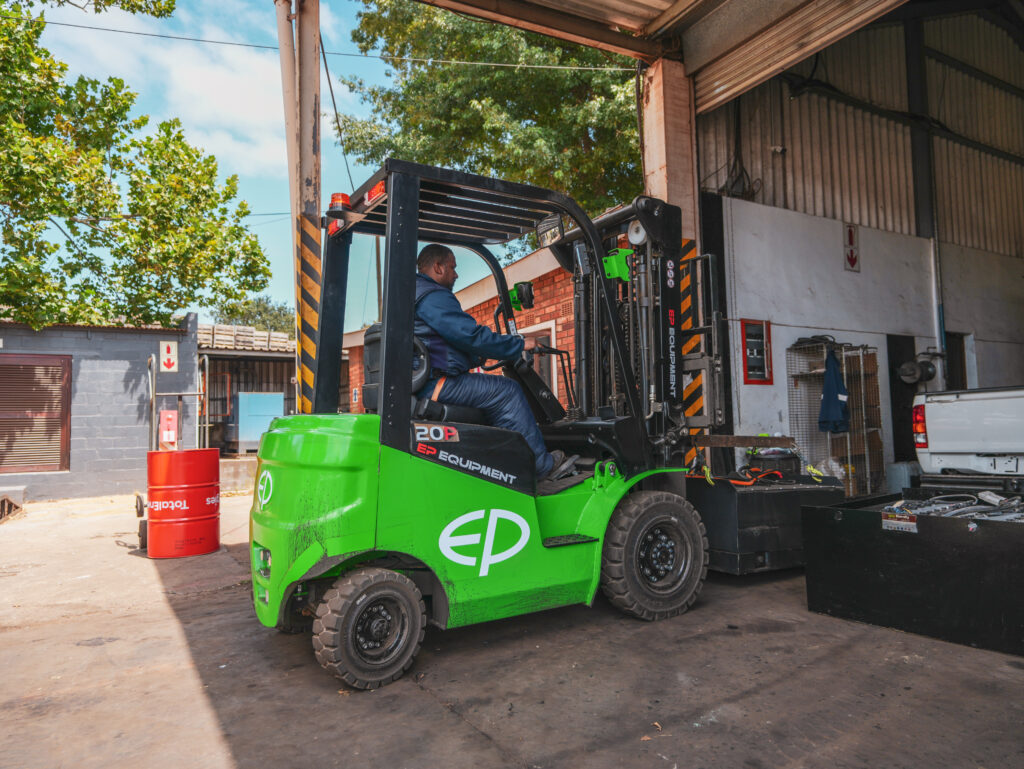
Electric forklifts operating in a modern South African distribution centre.
Where Diesel Still Makes More Sense
A guide that claims electric wins everywhere is a sales document, not an analysis. There remain applications where diesel or LPG equipment is the better engineering decision, and recognising them is part of specifying a fleet properly.
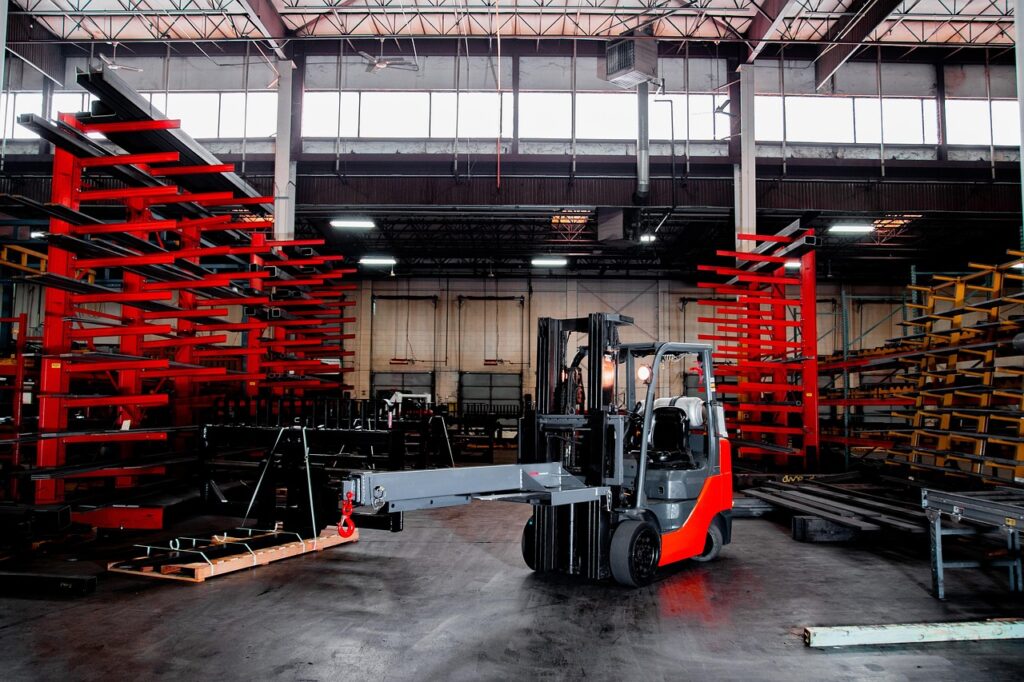
- Rough outdoor terrain. Uneven yards, gradients and unsurfaced ground place demands on a machine that many electric models are not built for.
- Sustained heavy-duty outdoor work. Continuous high-load operation across long shifts with no realistic charging window.
- Remote sites without practical power. If establishing adequate charging infrastructure means a substation, that cost belongs in the comparison.
- Very low utilisation. A machine running a few hours a week has too few operating hours to amortise the higher upfront cost of electric equipment.
- Genuinely unpredictable duty cycles. Opportunity charging depends on knowing roughly when breaks occur. Where demand is entirely irregular, that rhythm is harder to rely on.
If your operation includes both warehouse and yard work, a mixed fleet is usually the right answer — electric inside, combustion outside — rather than forcing a single powertrain across applications it does not suit.
Safety and Compliance Obligations in South Africa
Forklift operation in South Africa is regulated under the Occupational Health and Safety Act, and the obligations sit with the employer rather than the operator. These requirements are frequently overlooked in equipment discussions, and they carry real legal consequence.
- Operator certification. Under the Driven Machinery Regulations, no person may operate a forklift unless they have been trained and certified by an accredited training provider. Certificates are issued against the relevant unit standard and require periodic renewal.
- Medical fitness. Operators must be medically fit for the task, and employers are responsible for ensuring this remains current.
- Machine condition. General Safety Regulations require that dangerous machinery, including forklifts, is maintained in a safe working condition and used only for its intended purpose.
- Daily pre-use inspection. Operator checks before use are a requirement, not merely good practice.
Electric equipment carries its own specific considerations alongside these. Charging areas need appropriate ventilation and electrical protection, lithium-ion installations should be specified with a properly configured battery management system, and staff handling batteries require task-specific training. A competent supplier will raise these before you order, not after.
This section is a general summary and not legal advice. Confirm your obligations against the current regulations and your own risk assessment.
Choosing the Right Electric Forklift for Your Operation
No two warehouses are identical. A specification that performs in ambient distribution may be wrong for cold storage, and a battery strategy suited to a single-shift operation will be inefficient in a facility running around the clock. Before committing to equipment, work through the following.
Understand your duty cycle
Record actual operating hours, not estimates. How many shifts, how many hours per shift, what loads, what distances travelled, and where the natural breaks fall. Opportunity charging depends on those breaks, so knowing them precisely changes the specification.
Assess your power infrastructure honestly
Establish what charging capacity your site can support today and what upgrades would be required. This is the barrier most often discovered late, and it belongs in the business case from the beginning rather than as a variation order after delivery.
Match the machine to the environment
Aisle widths, racking height, floor condition, temperature and indoor versus outdoor use all narrow the field. A reach truck, a counterbalance forklift and a pallet truck solve different problems, and specifying the wrong class is an expensive way to discover that.
Model the total cost, not the price
Run the full TCO comparison over a realistic horizon using your own numbers. If the case only works on optimistic utilisation assumptions, it does not work.
Plan for the battery’s whole life
Understand the expected cycle life, the replacement interval, warranty terms and end-of-life handling before you sign. The battery is the most expensive component in the machine and the one that determines when your next capital event arrives.
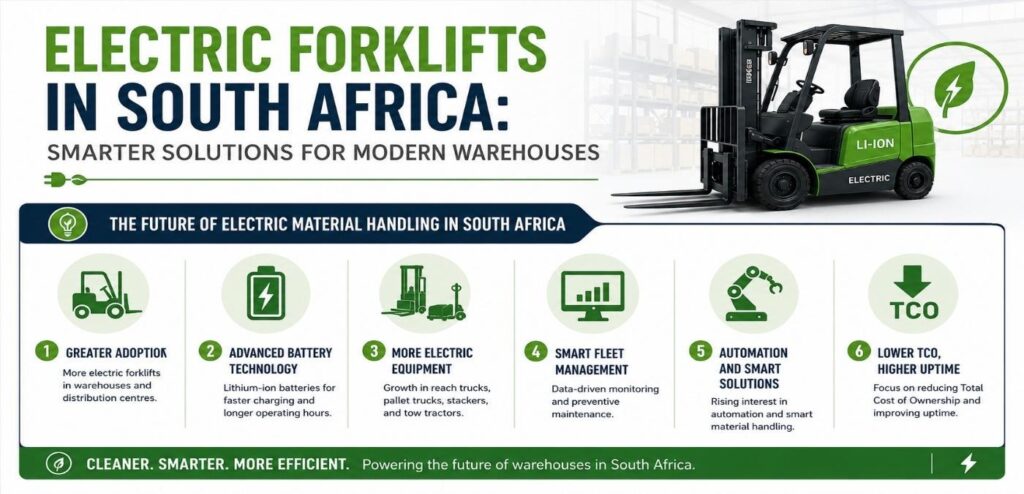
The Future of Electric Material Handling in South Africa
With electric already accounting for the majority of South African forklift revenue and growing faster than combustion equipment, the direction is settled. What changes next is the sophistication of how fleets are specified and run.
A sharper focus on measurable uptime and TCO as boards begin to treat material handling as a commercial decision rather than a procurement one.
Wider lithium-ion adoption as cycle-life and charging advantages become better understood, and as prices continue to fall.
Growing integration between forklift charging and on-site solar and battery storage, driven by grid reliability as much as by energy cost.
More investment in electric reach trucks, pallet trucks, stackers and tow tractors as operators electrify the whole fleet rather than only counterbalance machines.
Data-driven fleet management, with telematics informing preventive maintenance, operator training and utilisation decisions.
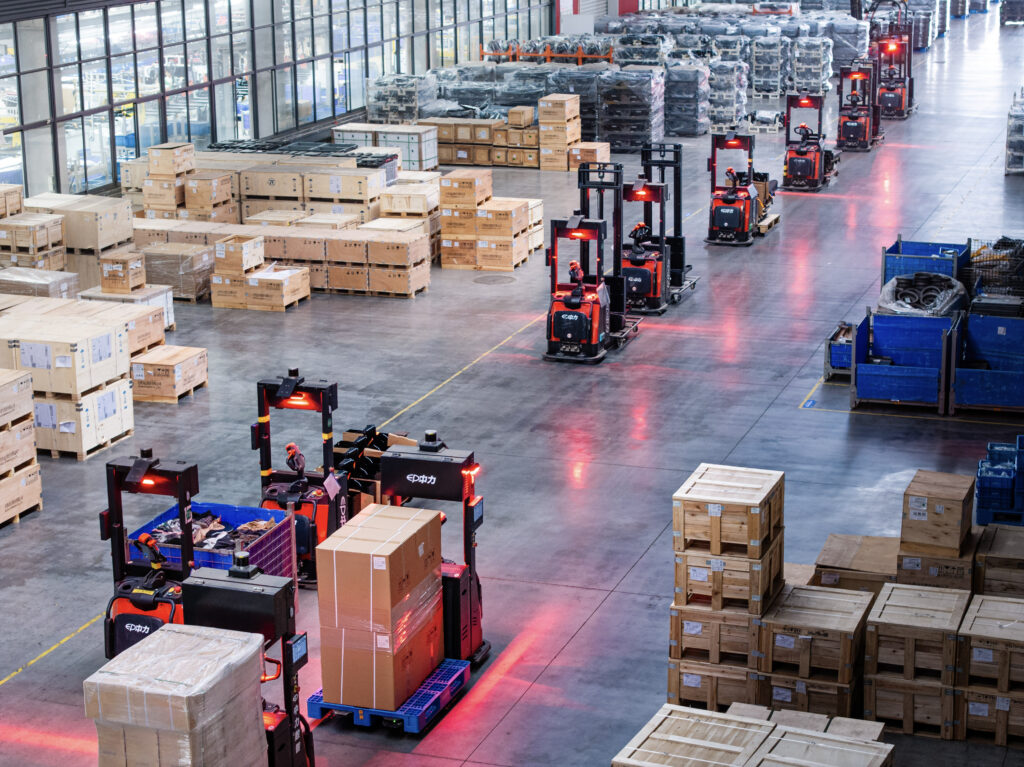
Increasing interest in automation and semi-automated material handling, particularly in high-throughput distribution.
Financing and service models that separate the battery from the machine, moving battery cost from capital expenditure to a predictable operating cost.
Frequently Asked Questions
Are electric forklifts powerful enough for heavy-duty work?
Yes, for the overwhelming majority of warehouse and distribution applications. Modern AC-motor electric forklifts deliver full torque from a standstill and hold consistent performance through the shift, because a lithium-ion battery maintains a flatter discharge curve than lead-acid. Where diesel still holds a genuine advantage is rough outdoor terrain, sustained heavy yard duty and remote sites with no practical power connection. The right question is not whether electric is powerful enough in general, but whether it suits your specific duty cycle.
What happens to electric forklifts during load-shedding?
This is the most common question South African operators ask, and the answer is more reassuring than most expect. Lithium-ion batteries charge in one to two hours and accept short opportunity charges of 15 to 30 minutes, so they can be topped up in the windows between outages. Lead-acid cannot do this — it needs roughly eight hours of charging plus a cooling period, which is very difficult to schedule around an unpredictable supply. Paired with solar, battery storage or a generator, a lithium fleet is often more resilient to grid interruption than a diesel fleet is to a fuel-price shock or a supply delay.
How long does a lithium-ion forklift battery last?
Industry sources consistently put lithium-ion forklift batteries at roughly 2,000 to 3,000 charge cycles, and some lithium iron phosphate packs exceed 3,000. In typical use that translates to about seven to ten years. Lead-acid batteries generally deliver 1,000 to 1,500 cycles, or around three to five years. Actual life depends on duty cycle, charging discipline, temperature and how well the battery management system is configured.
Is lithium-ion always better than lead-acid?
No, and any supplier who says otherwise is selling rather than advising. Lithium-ion is the stronger choice for multi-shift operations, high-utilisation sites and anywhere downtime is expensive. Lead-acid can still make sense for single-shift, lower-intensity operations where the upfront cost matters more than charging flexibility and there is a comfortable eight-hour window to charge overnight. The deciding factor is utilisation, not fashion.
How long does it take to charge an electric forklift?
A lithium-ion forklift battery reaches a full charge in roughly one to two hours with no cooling period required, and can be opportunity charged during breaks and shift changes. A lead-acid battery typically needs about eight hours to charge followed by a similar cooling period before it returns to service, which is why multi-shift operations running lead-acid usually need spare batteries and a dedicated battery-changing bay.
Do I need a licence to operate a forklift in South Africa?
Yes. Under the Occupational Health and Safety Act and the Driven Machinery Regulations, an employer may not permit anyone to operate a forklift unless that person has been trained and certified by an accredited training provider, and is medically fit. Competency certificates are issued against the relevant unit standard and require periodic renewal. This obligation sits with the employer, and it applies equally to electric and diesel machines.
Can electric forklifts work in cold storage?
Yes, and cold storage is one of the strongest use cases for electric equipment. There are no exhaust emissions to ventilate in a sealed, temperature-controlled space. Lithium-ion performs more predictably at low temperature than lead-acid, though cold does affect all battery chemistries, so packs intended for freezer work should be specified for it — thermal management and correct insulation matter. Discuss the operating temperature range with your supplier before ordering.
How much can an electric forklift save compared with diesel?
Savings vary too widely by utilisation, energy tariff and fuel price for a single honest figure to exist, and you should be sceptical of any supplier who quotes one without seeing your data. The savings come from three places: lower energy cost per hour worked, materially reduced maintenance, and less unplanned downtime. The only reliable way to size the number for your operation is to model your actual running hours, energy tariff and maintenance history.
Conclusion
Electric material handling is no longer the alternative choice in South Africa. It is the majority of the market, and the operational case behind it — lower running costs, less maintenance, better working conditions and charging flexibility that suits an unreliable grid — is stronger than it has ever been.
But the decision still has to be made properly. The right equipment depends on your duty cycle, your power infrastructure, your environment and your utilisation. Electric wins decisively in most indoor warehouse applications and still loses in some outdoor and heavy-duty ones. Any supplier unwilling to tell you which category you fall into is not giving you advice.
Orizen Group has spent more than 25 years helping South African businesses make these decisions with data rather than assumption. Speak to our technical team about a fleet assessment, or use our TCO Calculator to model the full cost of your current fleet against an electric alternative using your own operating hours and energy tariff.